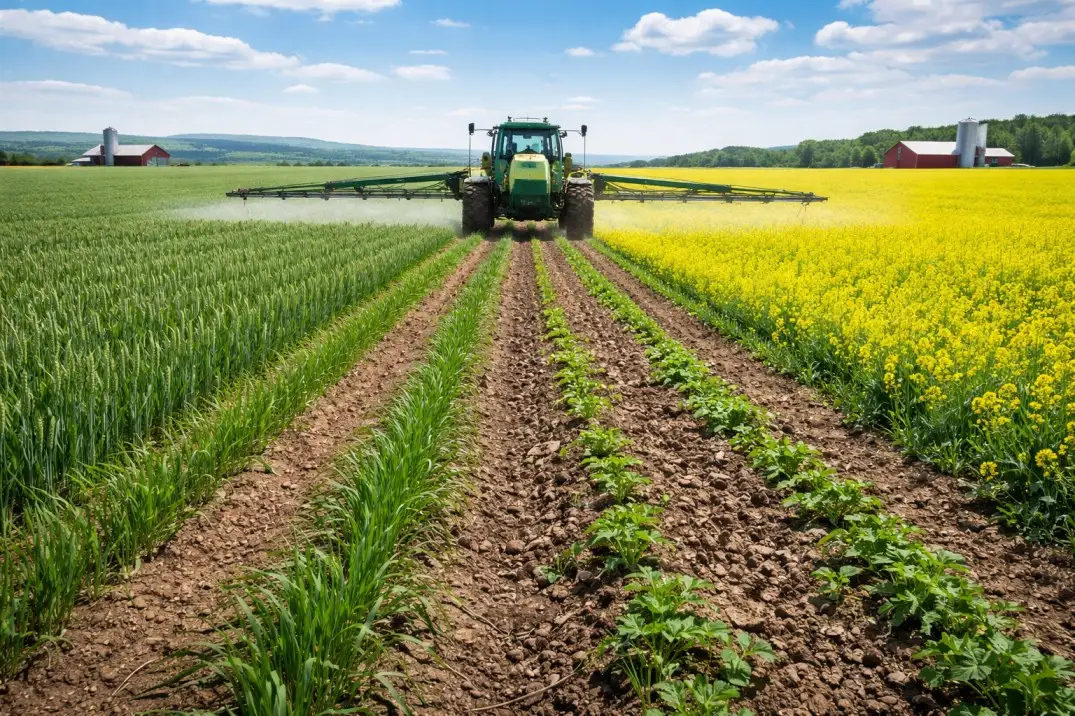
Weed control strategies across Canada have been reshaped over the past two decades. While post-emergent herbicides continue to hold an important place in agronomic programs, reliance on knockdown activity alone has increasingly been viewed as insufficient. Crops are often left vulnerable during early establishment when resistance pressure and unpredictable weather patterns intersect. Across both Western and Eastern Canada, stronger and more resilient systems have been sought by growers aiming to reduce variability and protect yield potential
One of the most consistent changes observed in modern programs has been the inclusion of a residual herbicide within pre-seed or pre-emergent applications. By ensuring residual activity is present early, a foundation for longer-lasting weed suppression is established before in-crop passes are required.
Limitations of Post-Only Programs
Post-emergent herbicides are, by design, reactionary treatments. Control measures are initiated only after weeds have emerged and begun competing with the crop. Even where effective chemistries are used, some degree of competition is often allowed to occur before application. During early establishment, competition for moisture, nutrients and sunlight can result in measurable yield loss. Even brief periods of unchecked weed growth during the critical establishment window have been shown to affect crop performance.
In Western Canada, recurring pressure from kochia, wild buckwheat, volunteer canola and cleavers is routinely reported. Many of these species exhibit resistance to multiple sites of action. In Eastern Canada, ragweed, lamb’s quarters and waterhemp continue to complicate soybean and corn rotations. Across both regions, multiple weed flushes are commonly triggered by timely spring moisture.
When programs are built solely around post-emergent chemistry, these flushes can exceed the control window of in-crop applications. Weeds may reach advanced growth stages before treatment is applied, reducing efficacy and increasing the likelihood of escapes. Each escaped plant contributes to future seed return, compounding resistance challenges over time.
Including Residual Protection Early
Residual herbicides function differently from post-emergent treatments. Rather than targeting visible weeds, control is provided to newly emerging seedlings after application. By maintaining a cleaner seedbed through the early growth stages, a longer window of weed suppression is created.
In both canola and soybean systems, benefits have been observed when fields are kept weed-free during early development. More uniform emergence and improved canopy formation are typically achieved under reduced early competition. When overall weed density is lowered before in-crop application timing, post-emergent herbicides are allowed to perform under less pressure and on smaller, more manageable weeds.
Through this layered approach, selection pressure within a single season is distributed across multiple modes of action. Resistance management objectives are therefore supported both within and between growing seasons.
Placement of Residual Herbicides Within Broadleaf Programs
Fierce EZ has been positioned to extend the effectiveness of in-crop broadleaf programs by providing residual activity on a wide spectrum of troublesome species. As a residual broadleaf herbicide in Canada, it strengthens early-season control before in-crop applications are required. When applied prior to crop emergence, control of species such as wild buckwheat, volunteer canola and cleavers in Western Canada, and lamb’s quarters and pigweed species in Eastern Canada, can be strengthened.
Rather than replacing existing broadleaf options, the performance of those tools is enhanced when the season is started with fewer weeds present. Reduced weed density at the time of in-crop application allows for more consistent control, as smaller weeds are generally easier to manage. Escapes that occur when weeds exceed optimal staging are therefore less likely.
Soil Interaction and Rainfall Considerations
The performance of residual herbicides is influenced by soil texture, organic matter content and available moisture. Binding characteristics vary between lighter soils with lower organic matter and heavier soils with higher clay content. In lighter soils, strict adherence to recommended rates and label instructions becomes especially important. In heavier soils, activation through rainfall is often required to move the herbicide into the germination zone.
Application timing in relation to rainfall events is critical. For optimal performance, residual herbicides are generally applied as close to planting as possible and before weed emergence. Delayed application increases the likelihood that weeds will emerge prior to activation, reducing effectiveness.
In Eastern Canada, seasonal variability can be pronounced. During dry springs, early-emerging weeds may gain an advantage by drawing moisture from the soil before crop establishment is complete. In contrast, wet springs often generate repeated flushes that intensify pressure on post-emergent programs. In both scenarios, residual protection provides a buffer, maintaining suppression through shifting conditions.
As crop rotations expand and resistance challenges intensify, complexity within Canadian agriculture continues to grow. By integrating a residual herbicide such as Fierce EZ into pre-seed programs, stronger in-crop systems are constructed. Improved early-season conditions support more consistent spray performance later, contributing to the overarching objective of season-long weed control and sustained productivity.