Growers face constant pressure to protect yields while managing rising herbicide costs and increasing weed resistance. Smart Weed Control offers a revolutionary approach by combining artificial intelligence with precision agricultural machinery to target threats at the earliest stages of crop growth. By understanding how computer vision and automated systems function, agricultural professionals can implement these tools to significantly reduce chemical inputs, protect plant health, and improve overall farm profitability.
Rising Challenge of Traditional Weed Management
Traditional broadcast spraying methods are becoming less effective and financially unsustainable for modern farming operations. Farmers often apply chemicals uniformly across entire fields, resulting in wasted resources and unnecessary environmental exposure. Furthermore, herbicide-resistant weed species are spreading rapidly, forcing growers to use higher chemical concentrations or complex tank mixes. This cycle continually drives up input costs while risking potential crop damage during sensitive early growth stages. Relying on manual scouting is equally problematic due to severe labor shortages across the global agricultural sector.
“Precision application is no longer a futuristic concept; it is an economic necessity for modern row crop production.”
Understanding Smart Weed Control
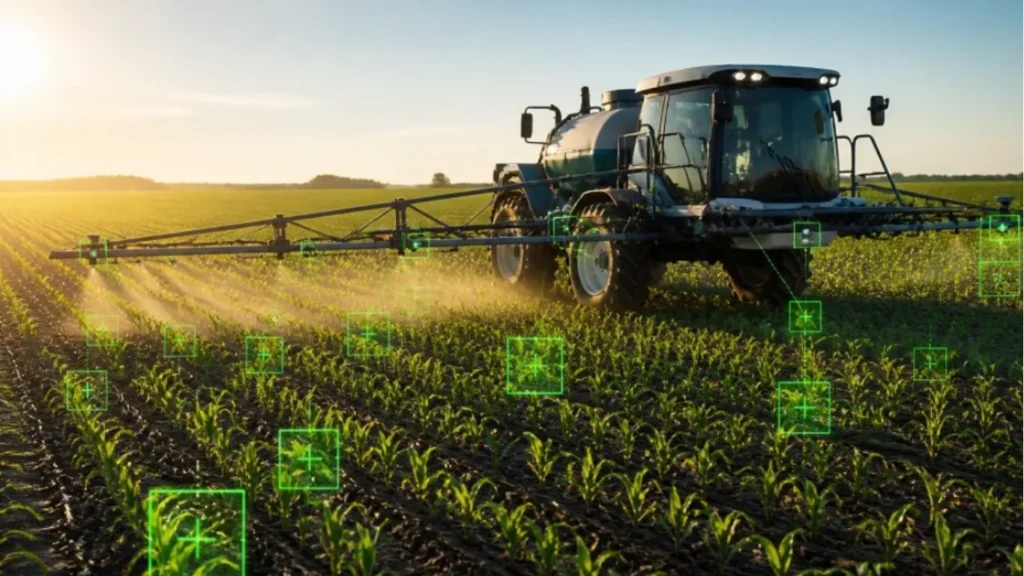
Smart Weed Control integrates artificial intelligence, machine learning, and advanced optics to distinguish weeds from cash crops in real time. Instead of treating an entire field uniformly, these intelligent systems identify specific plant locations and apply targeted interventions exactly where they are needed. The technology relies on a complex network of cameras, edge processors, and actuation mechanisms mounted on conventional tractors or autonomous rovers. This shift from broad field-level management to individual plant-level management represents a fundamental evolution in modern agronomic practices.
How Computer Vision Identifies Weeds
The core of any intelligent agricultural system is its artificial intelligence model, specifically Convolutional Neural Networks (CNNs). These deep learning models are trained on millions of annotated images, allowing the system to recognize plant species under varying lighting conditions, soil backgrounds, and growth stages. When the equipment moves through the field, high-speed cameras capture continuous video feeds that the onboard AI processes in milliseconds. To differentiate a weed from a crop, the computer vision algorithm evaluates several critical data points simultaneously.
- Leaf shape, edge serration, and overall morphological characteristics.
- Spectral reflectance, often utilizing hyperspectral imaging for invisible light data.
- Plant spacing and expected geometric patterns within established crop rows.
- Canopy height and temporal development differences between species.
Overcoming Environmental Variables in Field Detection
Operating computer vision algorithms in a controlled laboratory is vastly different from running them in a dynamic agricultural environment. AI models must account for extreme lighting fluctuations, sudden cloud cover, and harsh shadows cast by the tractor canopy. Advanced Smart Weed Control systems utilize localized illumination modules, such as high-intensity LED strobes, to normalize the lighting environment beneath the camera shroud. Additionally, the neural networks are rigorously trained to handle occlusion, recognizing weeds even when they are partially hidden by crop leaves, heavy dust, or residual cover crop biomass.
Precision Spraying and Mechanical Removal
Once the artificial intelligence identifies a weed, the system must immediately execute a control mechanism. In chemical applications, this is achieved using pulse-width modulation (PWM) nozzles that open and close in fractions of a second, delivering a micro-dose of herbicide directly onto the target leaves. For organic operations or areas with severe herbicide resistance, the system replaces spray nozzles with automated mechanical actuators. These robotic arms or rotating blades physically uproot the weed without disturbing the surrounding soil or the cash crop’s root system.
Control Method | Mechanism | Best Application Scenario |
Spot Spraying | PWM nozzles deliver targeted chemical doses | Large-scale conventional row crops |
Laser Weeding | High-powered thermal lasers destroy meristems | High-density vegetable operations |
Mechanical Hoeing | Robotic arms or blades physically uproot plants | Organic farming and resistant weed zones |
Key Benefits of AI in Weed Management
Transitioning to AI-driven weed management systems provides immediate agronomic advantages alongside substantial long-term economic benefits. Growers who adopt these technologies often see a dramatic transformation in their chemical budgeting, operational efficiency, and crop health metrics. By addressing weed pressure with pinpoint accuracy, farms can optimize their labor allocation while adhering to increasingly strict environmental regulations. The precision offered by these intelligent systems directly resolves the core financial inefficiencies of historical farming methods.
Significant Herbicide Reduction
The most immediate financial return from intelligent weed management is the drastic decrease in chemical usage. Because the system only applies herbicide to actively identified weeds rather than bare soil or cash crops, the total volume of required chemicals plummets. This targeted approach significantly alters the economics of weed control for large-scale operations.
- Reduction in total herbicide volume by up to 90 percent compared to broadcast spraying.
- Extended lifecycle and efficacy of existing herbicide chemistries by reducing resistance pressure.
- Decreased chemical runoff into local watersheds and surrounding ecosystems.
- Lower risk of phytotoxicity and chemical stunting in sensitive cash crop varieties.
Early Detection and Crop Protection
The critical weed-free period is the specific window during a crop’s lifecycle when weed competition causes the most severe yield loss. Smart Weed Control systems excel at early detection, identifying invasive plants at the cotyledon or early seedling stage when they are most vulnerable to intervention. Removing weeds this early ensures that water, sunlight, and expensive soil nutrients are exclusively utilized by the developing cash crop. By maintaining a pristine growing environment during the early vegetative stages, farmers secure their crop’s maximum genetic yield potential.
Utilizing Weed Mapping Data for Predictive Agronomy
Beyond immediate weed eradication, Smart Weed Control systems generate an invaluable byproduct through high-resolution, georeferenced field data. As the optical sensors scan the rows, they record the exact GPS coordinates, species density, and growth stage of every identified weed. This data seamlessly integrates into farm management information systems, creating comprehensive weed pressure heat maps. By analyzing these maps over multiple seasons, agronomists can identify problematic field zones, adjust crop rotation schedules, and optimize pre-emergence herbicide programs.
Enhancing Soil Health and Minimizing Compaction
Heavy reliance on repeated tractor passes for traditional spraying or aggressive broadcast tillage severely degrades soil structure over time. By maximizing the efficiency of each pass, intelligent systems inherently reduce soil compaction, preserving vital pore space for root expansion and water infiltration. Furthermore, eliminating unnecessary herbicide application protects the delicate soil microbiome. Beneficial microorganisms, earthworms, and mycorrhizal fungi thrive when chemical loads decrease, directly improving nutrient cycling and overall soil fertility.
Implementing Intelligent Weed Systems
Adopting smart weed management requires careful planning and a thorough evaluation of existing farm infrastructure. Professional growers must assess their specific operational needs, ranging from tractor hydraulic capacity to the specific weed species dominating their fields. Successful implementation merges high-tech hardware with strong agronomic knowledge, ensuring the machine learning models are properly calibrated for local conditions. Understanding the necessary steps for deployment ensures a smoother transition and a faster realization of the technology’s maximum value.
Assessing Farm Compatibility
Before investing in advanced AI systems, farm managers must evaluate their current equipment and field conditions. High-clearance sprayers must have adequate boom stability, as excessive bouncing can blur the camera feeds and reduce the AI’s detection accuracy. Additionally, operations must consider their typical operating speeds, as processing times dictate how fast the tractor can move while maintaining precise application. Network connectivity is also a factor; while edge computing allows real-time field processing without internet access, software updates and model training require stable data connections.