Looking to estimate how much compost you need for new or established lawn, garden, raised bed, and trees or shrubs? Then you are at the right place where you can easily get calculated proper needs of compost by using our compost calculator. Easily get the proper estimate only by putting the length and width in feet and the desired depth in inches, you will get the best results showing the compost.
Calculate Amount Needed
Optimize Your Compost Pile
Achieve the ideal C/N ratio of 25:1 – 30:1 for rapid decomposition.
Add more ‘Browns’ (leaves, cardboard) to prevent odor.
How to Use Our Compost Calculator
Buying too much compost wastes money. Buying too little means another trip to the store halfway through your project. Compost calculator helps you avoid both — just plug in a few numbers and you’ll know exactly what you need before you spend a cent.
Here’s how it works.
1. Select Your Area Shape
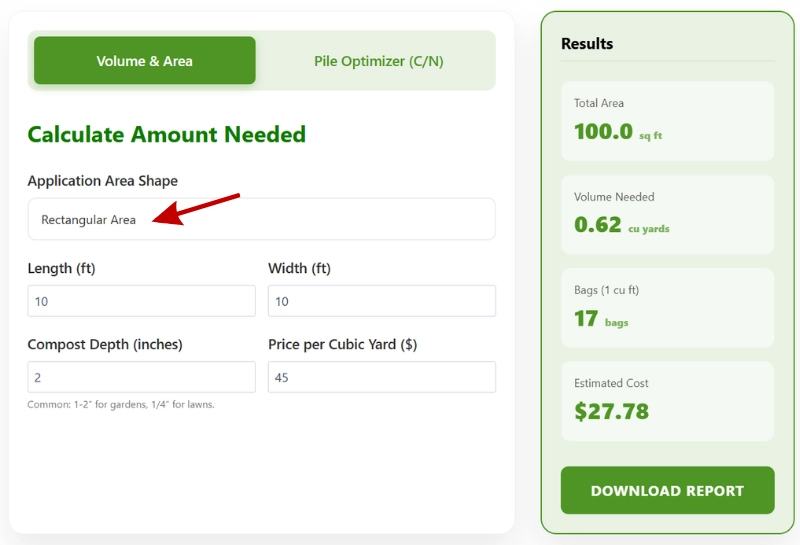
First, pick the shape that matches your space. For most people, that’s a rectangle — typical for garden beds, lawns, or raised planters. Getting this right from the start means everything else calculates accurately.
2. Enter Your Dimensions
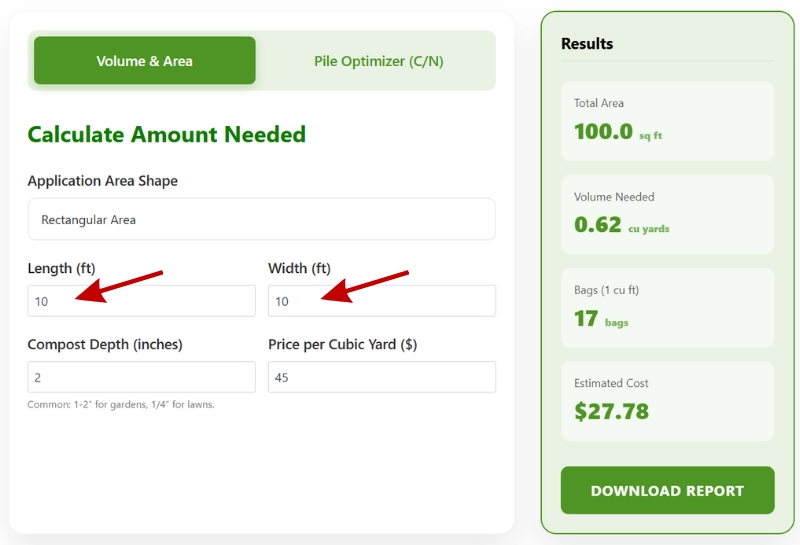
Type in the length and width of your area in feet. Measure twice if you can — even being off by a foot or two makes a difference once you’re calculating cubic volume. A 10 × 10 ft patch, just for reference, gives you 100 square feet to work with.
3. Set Compost Depth
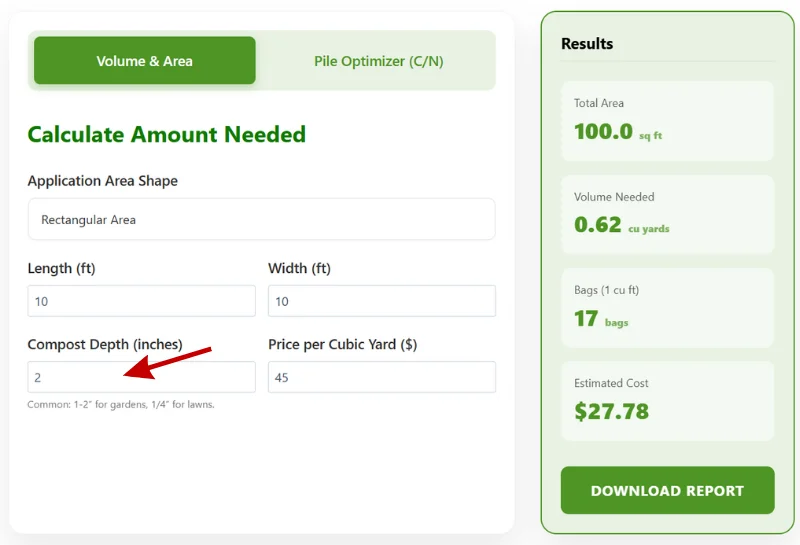
This one depends on what you’re actually doing. Vegetable beds and new planting areas usually need somewhere between 1 and 2 inches mixed into the soil. Lawns are a different story — a quarter to half an inch is plenty for a top-dressing. Think about your soil’s current condition before you decide; a compacted clay bed needs more than something that’s already fairly healthy.
4. Add a Price per Cubic Yard (Optional)
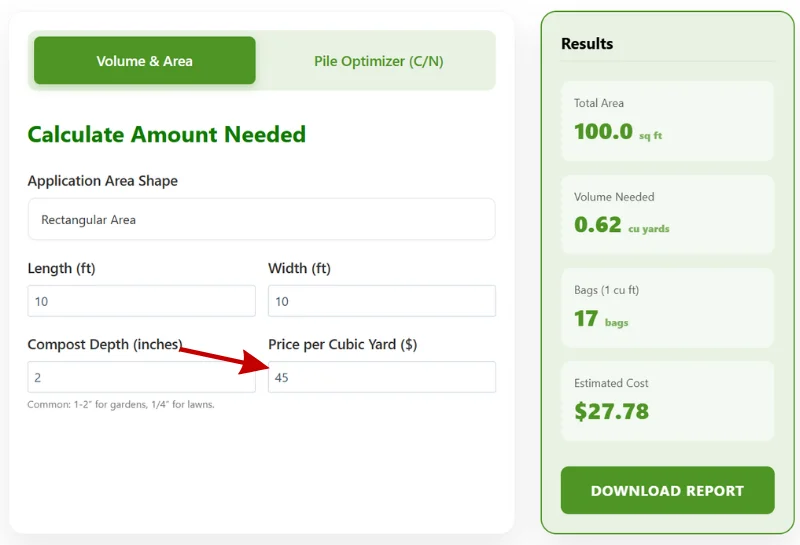
Not required, but worth doing. Enter what your supplier charges per cubic yard and compost calculator will show your total spend alongside the volume. Prices shift depending on where you live and what type of compost you’re buying, so it’s worth checking locally before you fill this in.
5. Check Your Results
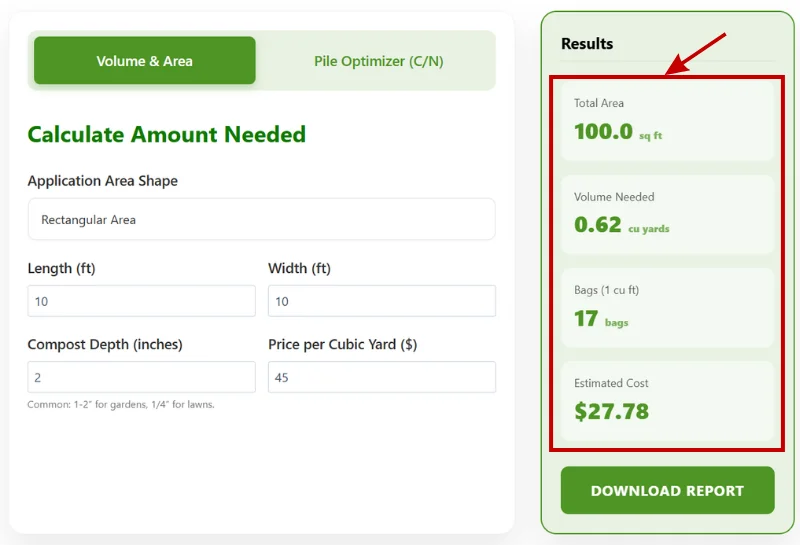
Once everything’s entered, the results show up immediately — total area, how much compost you’ll need by volume, and the number of bags to grab. If you added pricing, your estimated cost is there too. No spreadsheet, no manual math.
6. Save or Download Your Report (Optional)
Heading to the garden center? Download the summary first. It’s a simple reference to have on hand when you’re loading bags into a cart or asking a supplier about bulk pricing. Handy if you’re planning a bigger project and want to keep the numbers somewhere.
Using the Pile Optimizer (C/N)
Once you’ve figured out how much compost you need, the next step is making sure what goes into the pile actually breaks down properly. Switch over to the “Pile Optimizer (C/N)” tab and this is where things get a bit more hands-on.
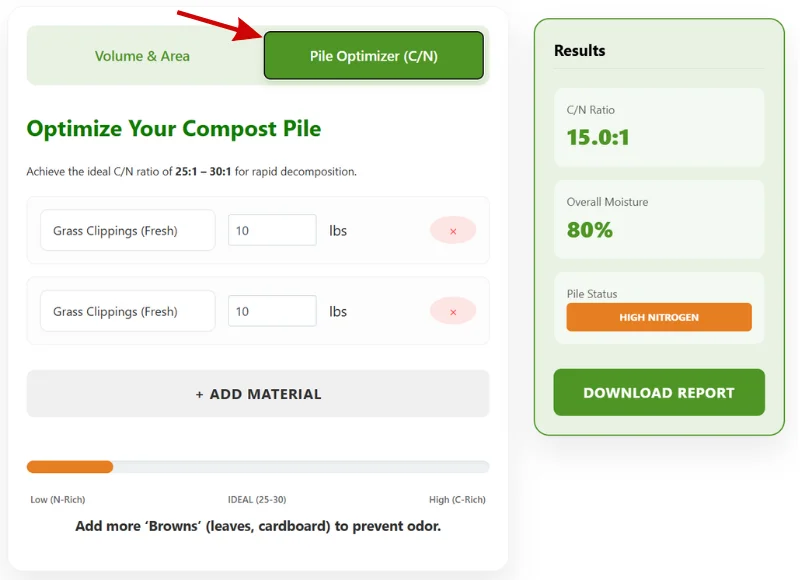
You’ll add the materials you’re working with — grass clippings, dry leaves, cardboard, kitchen scraps, whatever you’ve got — and the tool works out your carbon-to-nitrogen ratio in real time. It also gives you a read on moisture levels and flags the overall condition of your pile, so you’re not just guessing whether it’s on track or quietly rotting in the corner of your yard.
Getting the Balance Right
The optimizer doesn’t just spit out numbers — it tells you what to do with them. If your ratio is off, it’ll suggest whether you need to throw in more “browns” or more “greens.”
Browns are your carbon sources: dry leaves, cardboard, straw, wood chips. Greens bring the nitrogen: fresh grass clippings, food scraps, coffee grounds. You need both, and the ratio between them matters more than most people realize. Somewhere between 25:1 and 30:1 is the sweet spot for active, fast decomposition.
Lean too heavy on the greens and your pile starts to smell — too much nitrogen with nowhere to go. Too many browns and it just sits there, barely breaking down. The optimizer catches these problems early and points you toward the fix, which saves a lot of trial and error over weeks of waiting.
How to Calculate Compost Manually
Using the proper ratio of compost is very significant as it is essential for growing your trees, plants, grass, raised beds, shrubs, and flowers. There is no single ratio or amount of compost used for every soil, so keep it in mind and calculate it properly. If you want to calculate the need for compost for your soil yourself, then follow the instructions.
Fresh Lawn
For a fresh lawn, add 1 to 2 inches of compost to the top 6-8 inches of soil to improve structure and nutrients, or apply compost after seeding as a nutrient-rich top dressing.
Existing Lawn
Apply 1/4 to 1/2 inch of fine, sifted compost to an existing lawn after aeration, preferably once or twice a year.
Garden and Raised Bed
Use 1 to 2 inches of compost on the top 6 to 8 inches of garden soil and raised bed for better dressing and making the soil nutrient efficient.
Compost Ratio Chart
| Material Type | Examples | C:N Ratio & Notes |
| Nitrogen | Fruit & veggie scraps, grass clippings, coffee grounds, manure | 15–25:1 — adds nitrogen, fast to break down, keeps compost hot |
| Carbon | Dry leaves, straw, paper, cardboard, wood chips | 60–400:1 — adds carbon, prevents odor, gives compost structure |
| Balanced Mix | 1 part greens + 2–3 parts browns | ≈ 30:1 ideal ratio — moist like a wrung sponge, turn weekly for aeration |
Conclusion
After reading all the above information, you are now ready to calculate the need for compost for your soil. There is a simple calculation method, but if there is a question in your mind about how much compost I need for my lawn, garden, or raised bed, then use our compost calculator.
FAQ’s
How do I calculate how much compost I need?
You can calculate it by using the formula:
Total cubic yards = [Length × Width × (Depth / 12)] / 27.
How much area does 1 yard of compost cover?
In a 2-inch depth, a yard of compost covers approximately 100 to 162 square feet, but coverage varies significantly with thickness.
How much compost per 1000 square feet?
Apply 3/4 to 1 cubic yard of compost per 1,000 square feet, to a depth of 1/4 to 3/8 inch.
What are the ideal ratios for compost?
Composting generally requires a carbon/nitrogen ratio of 30:1 or 30 parts carbon for every part nitrogen by weight.