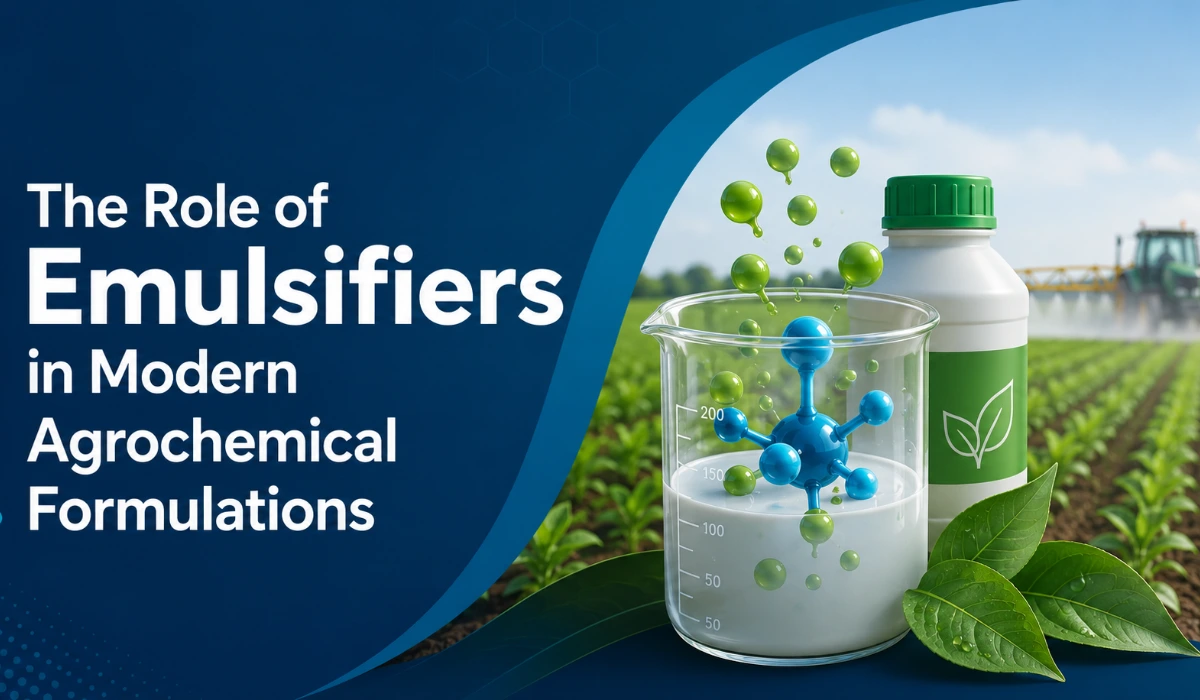
Emulsifiers are among the most important functional ingredients in modern agrochemical formulations. When an active ingredient is oil-soluble but has to be diluted in water and sprayed evenly across a field, emulsifiers make that possible. They allow two liquids that would normally separate to stay blended as fine, stable droplets, so the pesticide, herbicide, or fungicide is delivered uniformly to the target crop. For formulators, procurement teams, and manufacturers, choosing the right emulsifier system directly affects product stability, spray performance, and field efficacy. This article explains what agrochemical emulsifiers do, why they matter, and how to select them.
What Are Emulsifiers in Agrochemical Formulations?
Emulsifiers are surface-active agents (surfactants) that reduce the interfacial tension between two immiscible phases, typically oil and water, allowing them to form a stable emulsion. In an agrochemical context, the active ingredient is often dissolved in an organic solvent, and the emulsifier lets this oil phase disperse into water when the concentrate is diluted in the spray tank.
A single emulsifier rarely does the whole job. Most agrochemical products use a blended emulsifier system that pairs a non-ionic surfactant (such as an ethoxylated alcohol or ethoxylated castor oil) with an anionic surfactant (such as calcium dodecylbenzene sulfonate). Together they build a protective film around each droplet and keep the emulsion from breaking during storage and application.
Key Functions and Benefits of Agrochemical Emulsifiers
The value of an emulsifier is measured by how well the finished product performs from the drum to the droplet. Well-designed emulsifier systems deliver several practical benefits:
- Spontaneous emulsification: The concentrate forms a uniform, milky emulsion the moment it is added to water, without vigorous stirring.
- Emulsion stability: Droplets stay dispersed rather than creaming, coalescing, or separating in the spray tank over the working period.
- Consistent active delivery: Even distribution of the active ingredient means more reliable coverage and dosing across the sprayed area.
- Storage stability: The concentrate resists phase separation and crystallization across a range of temperatures and shelf-life conditions.
- Improved wetting and spreading: Many emulsifier blends also help the spray droplets wet and adhere to leaf surfaces, supporting uptake.
- Compatibility: Good systems tolerate hard water and tank mixing with other products.
The concept of Hydrophilic-Lipophilic Balance (HLB) guides much of this work. Oil-in-water emulsions used in agrochemicals generally require emulsifiers or blends with a higher HLB range, and formulators fine-tune the ratio of hydrophilic to lipophilic components to match the specific oil phase.
Applications Across Agrochemical Formulation Types
Emulsifiers appear in most liquid formulation categories, each with different requirements:
- Emulsifiable Concentrates (EC): The classic use. The active is dissolved in solvent with emulsifiers so it self-emulsifies on dilution. EC formulations depend heavily on a robust emulsifier package.
- Emulsions, Oil in Water (EW): A pre-formed emulsion that reduces or removes the organic solvent, offering a safer, lower-VOC profile while still relying on emulsifiers for stability.
- Suspoemulsions (SE): Combine suspended solid particles with emulsified oil droplets in one product, demanding carefully balanced emulsifier and dispersant systems.
- Microemulsions (ME): Use higher surfactant levels to form transparent, thermodynamically stable systems with very fine droplets.
- Oil dispersions and seed-treatment formulations: Also depend on emulsification and wetting agents for even application.
Because herbicides, insecticides, and fungicides each carry different active chemistries and solvents, the emulsifier system is tailored to the formulation rather than applied as a one-size-fits-all additive.
How to Choose the Right Emulsifier for an Agrochemical Formulation
Selecting an emulsifier is a formulation-specific decision. Several factors guide the choice:
- Nature of the active and solvent: The polarity and type of the oil phase determine the required HLB and the best surfactant chemistry.
- Formulation type: An EC, EW, and SE each call for different emulsifier structures and loading levels.
- Emulsion and storage stability: Candidates should be screened for performance under heat, cold, and freeze-thaw cycling, and over the intended shelf life.
- Water quality tolerance: The system should perform in hard water and across the pH range likely in the field.
- Compatibility: It must remain stable in common tank mixes and with co-formulants.
- Regulatory and safety profile: Ingredients should align with the relevant regional registration and safety requirements for crop protection products.
- Consistency and supply: Batch-to-batch uniformity matters, because small variations in the surfactant can shift emulsion quality.
Formulators typically test emulsifier blends at different ratios and concentrations, then confirm performance through standard emulsion stability and dilution tests before scaling up.
Why Work With a Reliable Emulsifier Manufacturer or Supplier
Emulsifier performance is only as dependable as the supply behind it. Consistent quality, accurate documentation, and technical support reduce reformulation risk and protect finished-product performance. A capable specialty chemical supplier can provide surfactant and emulsifier grades suited to specific formulation types, offer guidance on blend selection and HLB matching, supply the technical and regulatory documentation registration requires, and support bulk and export volumes for commercial production.
Conclusion
Emulsifiers play a central role in modern agrochemical formulations, turning oil-soluble actives into stable, sprayable products that deliver active ingredients evenly across the field. From emulsifiable concentrates to suspoemulsions, the right emulsifier system determines whether a product remains stable in storage, emulsifies cleanly on dilution, and performs in the tank. Choosing the correct emulsifier means matching its chemistry, HLB, and stability to the specific formulation and end-use conditions.