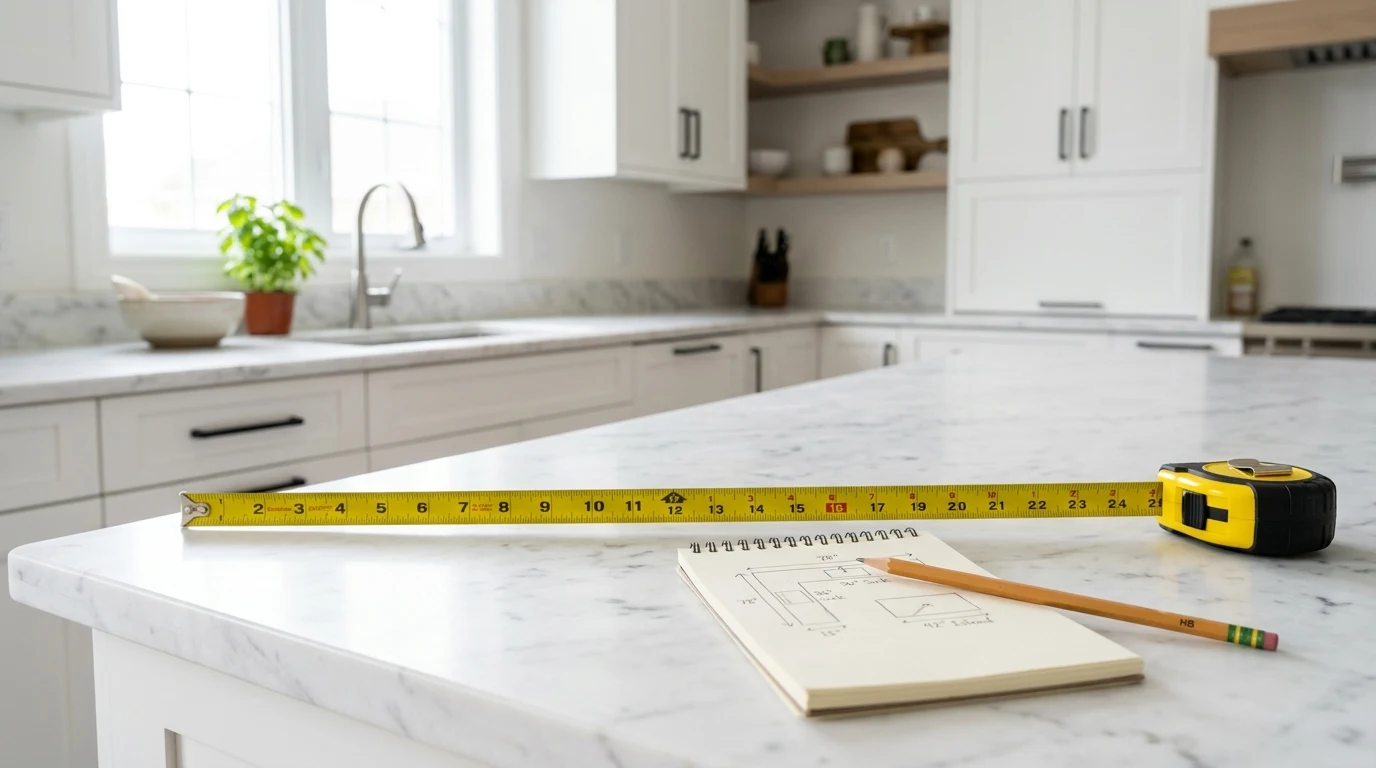
If you want to know how to figure out square feet of countertop, start by measuring the length and width of each countertop section. Countertops are usually measured in inches, while square footage is calculated in feet, so the measurements need to be converted before doing the final calculation. This method works for many kitchen islands, bathroom vanities, peninsula counters, and standard countertop layouts. Taking accurate measurements before ordering materials can help you estimate how much countertop you need and reduce costly mistakes.
Countertop Square Footage Calculator
Enter the length and depth of each countertop section in inches. Add sections for L-shaped, U-shaped counters, or islands.
Why Measure Countertop Square Footage?
Knowing the square footage of your countertop can help when you’re budgeting for a renovation or comparing material prices. Countertop materials such as quartz, granite, marble, laminate, and solid surface are often priced by the square foot, although fabricators may use additional pricing factors. An accurate measurement gives you a useful starting point for estimating the material cost. You may still need a professional measurement before fabrication because sinks, backsplashes, seams, edges, and unusual shapes can affect the final price.
1. Divide the Countertop Into Sections
The easiest way to learn how to figure out square feet of countertop is to divide an irregular countertop into simple rectangular sections. For example, an L-shaped kitchen counter can usually be separated into two rectangles that can be measured independently. A countertop with an island can also be divided into separate areas instead of trying to calculate the entire layout at once. Breaking the space into smaller sections makes the measurements easier to check and helps reduce calculation errors.
2. Measure the Length of Each Section
Measure the length of each countertop section from one end to the other. Use a tape measure and record the measurement in inches if that is the easiest unit for your space. Measure along the countertop surface rather than estimating based on cabinets or walls. If multiple sections have different lengths, write each measurement down separately so you can calculate their areas individually.
3. Measure the Countertop Depth
Next, measure the depth of each countertop section from the back edge to the front edge. A standard kitchen countertop is often around 25 to 26 inches deep, but actual dimensions can vary depending on the cabinets, overhang, and design. Islands and breakfast bars may have significantly different depths, so don’t assume every section has the same measurement. Accurate depth measurements are an important part of understanding how to figure out square feet of countertop for a real project.
4. Convert Inches to Feet
If your measurements are in inches, divide each measurement by 12 to convert it into feet. For example, a countertop that is 96 inches long is 8 feet long, while a 25-inch depth is about 2.08 feet. You can then multiply the length in feet by the depth in feet to find the square footage of that section. Keeping your measurements in the same unit throughout the calculation helps prevent mistakes.
5. Calculate and Add the Sections
The basic formula for a rectangular countertop section is length × depth = square feet. For example, if a section is 8 feet long and 2.08 feet deep, multiply 8 by 2.08 to get approximately 16.64 square feet. Repeat the calculation for every countertop section and then add the individual areas together. This is the basic method for how to figure out square feet of countertop when the layout consists of rectangular areas.
Example of a Countertop Calculation
Suppose you have one countertop section that is 120 inches long and 25 inches deep. Converting those measurements gives you 10 feet in length and approximately 2.08 feet in depth. Multiply 10 by 2.08, and the countertop section measures approximately 20.8 square feet. This example shows why converting measurements to feet before multiplying is useful when calculating countertop square footage.
How to Measure an L-Shaped Countertop
L-shaped countertops can look complicated, but they can usually be calculated by treating the layout as two separate rectangles. Measure the length and depth of the first section, calculate its square footage, and then repeat the process for the second section. Add the two results together to get the approximate total countertop area. Be careful not to count the shared corner area twice, because overlapping measurements can make your total larger than the actual countertop surface.
Should You Include the Sink Area?
For a basic material estimate, you generally start with the total countertop surface area rather than automatically subtracting every opening. A sink cutout may reduce the actual amount of material covering the surface, but countertop pricing and fabrication often depend on more than simple square footage. The same applies to cooktop openings and other cutouts. If you’re using the measurement to order material, ask the supplier or fabricator how they calculate charges so you know whether those areas should be deducted.
What About Countertop Overhangs?
Overhangs can affect the amount of material required, especially on islands, breakfast bars, and peninsulas. Instead of measuring only the cabinet footprint, measure the full countertop surface from the back edge to the front edge. This ensures that the additional material extending beyond the cabinets is included in your estimate. When learning how to figure out square feet of countertop, measuring the actual finished surface is more useful than relying solely on cabinet dimensions.
Should You Add Extra Material?
A small amount of additional material may be necessary for fabrication, seams, cuts, or layout considerations. The exact amount depends on the countertop material, shape of the kitchen, and fabricator’s requirements. You shouldn’t simply add a large percentage without checking the supplier’s recommendations because different materials and layouts have different fabrication needs. For a final order, a professional countertop fabricator can determine the required slab size and account for waste and cuts.
Common Measurement Mistakes to Avoid
One common mistake is confusing linear feet with square feet, since they measure different things. Another mistake is forgetting to convert inches to feet before multiplying length and depth. People also sometimes measure only the cabinet dimensions and overlook overhangs or areas with different depths. Taking measurements twice and writing down every section separately can make the process of how to figure out square feet of countertop much more reliable.
Final Thoughts
Learning how to figure out square feet of countertop is straightforward when you divide the surface into manageable sections and measure each one carefully. Measure the length and depth, convert the measurements to feet, multiply them together, and add the areas of all sections. This calculation can give you a useful estimate for planning a countertop project and comparing material costs. For a final fabrication order, however, use the measurements provided or verified by your countertop supplier or professional fabricator.