What is R-value in insulation? It measures how strongly insulation resists heat flow. A higher R-value means greater resistance to heat flow, helping limit heating and cooling demand. The package number doesn’t tell the whole story. I consider climate, available space, and existing insulation before choosing a rating.
Configure your assembly, climate zone, and project scope below, then click Calculate Insulation to generate your thermal report.
What Is R-Value in Insulation?
Think of insulation as a barrier that slows heat transfer, rather than a blanket that creates warmth. R-value tells us how effective that barrier is under specified testing conditions.
How R-Value Measures Resistance to Heat Flow
Heat naturally moves from warm areas to cool ones. During winter, that often means heat escaping through the roof, walls, and floors; in summer, outdoor heat can travel into air-conditioned rooms. Insulation slows that flow, helping maintain steadier indoor temperatures.
I always separate insulation from air sealing. A well-rated batt won’t stop a draft slipping through a gap beside it, and an air leak can undermine an otherwise good insulation upgrade.
What Do R-13, R-19, R-30 and R-60 Mean?
An R-number tells you how much thermal resistance a product provides. You might see these labels:
- R-13 or R-15: Common options for some 2×4 wall cavities.
- R-19 or R-21: Often used in appropriately sized deeper wall cavities or certain floors.
- R-30 or R-38: Familiar ratings for ceilings and attic insulation.
- R-49 or R-60: Higher insulation levels frequently recommended for colder-region attics.
I wouldn’t choose R-60 simply because it sounds impressive. The right number depends on the whole building assembly and the climate where you live.
How Is Insulation R-Value Calculated?
For a quick estimate, you can multiply a material’s approximate R-value per inch by its installed thickness. That shortcut works best for uniform insulation and isn’t a substitute for the manufacturer’s stated rating.
Understanding R-Value Per Inch of Insulation
Suppose a product provides R-3 per inch. Ten inches would provide roughly R-30; six inches, R-18. Closed-cell spray foam can provide more R-value than equal-thickness loose-fill fiberglass, though the label still matters.
Can You Add R-Values Together?
Properly installed layers generally add their R-values. An R-19 layer plus another R-19 layer gives approximately R-38 before accounting for framing.
When evaluating a layered setup, I check three things:
- Are both layers installed at their intended thickness without being squashed?
- Are there gaps, framing members, or uncovered edges that bypass the insulation?
- Are the new materials compatible with the existing vapor and moisture-control design?
R-Value vs. U-Value: What’s the Difference?
R-value measures resistance to heat flow; U-factor measures the rate of heat transfer through an assembly under a temperature difference. For the same assembly, using consistent units, U = 1 ÷ R. That means higher R-values and lower U-factors generally indicate better thermal performance. U.S. R-values and metric RSI values use different units; U.S. R-30 is approximately RSI 5.3.
What R-Value Do You Need for Your Home?
There’s no single recommended insulation R-value for every house. I start with the local climate zone and the part of the building being insulated, then compare that with existing insulation and applicable building requirements.
Recommended Insulation R-Values by Climate Zone
ENERGY STAR publishes the following retrofit guidance for existing wood-framed U.S. homes. The second attic column means additional insulation to install when 3–4 inches already exists, not the final combined R-value.
| U.S. climate zone | Add to bare attic | Add if attic already has 3–4 inches | Floor insulation |
|---|---|---|---|
| 1 | R-30 | R-25 | R-13 |
| 2 | R-49 | R-38 | R-13 |
| 3 | R-49 | R-38 | R-19 |
| 4A–4B | R-60 | R-49 | R-19 |
| 4C, 5–6 | R-60 | R-49 | R-30 |
| 7–8 | R-60 | R-49 | R-38 |
These are retrofit recommendations, not a replacement for local code or a design for every roof assembly. Check your climate zone and local rules before buying. Source: ENERGY STAR recommended R-values.
What R-Value Is Best for Attic and Ceiling Insulation?
Attics are often a good starting point because they’re accessible and separate conditioned rooms from extreme roof temperatures. R-30, R-38, R-49, and R-60 can all make sense, depending on the climate zone and the insulation already present.
Before picking a target, I’d check:
- Whether the insulation lies on the attic floor or under the roof deck.
- Its current depth, coverage, and approximate R-value.
- Whether vents, attic hatches, or recessed lights need special treatment.
For hot, humid homes, our guide to Florida attic insulation offers local context.
Recommended R-Values for Exterior Walls
Wall cavities have physical limits. Standard 2×4 framing commonly accepts appropriately sized R-13 or R-15 batts, while 2×6 cavities can accommodate products around R-19 to R-21.
But wood studs conduct more heat than the insulation between them, creating thermal bridges. For an exterior renovation, I would consider continuous rigid insulation outside the studs when the wall design and code allow it. ENERGY STAR’s retrofit guidance includes additional R-5 to R-10 insulating sheathing for certain climates and wall conditions.
Floor, Basement, Crawlspace and Garage Insulation
Insulation underneath a floor above an unconditioned space reduces heat transfer through that floor. Basement and crawlspace walls require their own strategy, particularly where ground moisture and condensation are concerns.
My priorities would be:
- Match floor insulation to the climate-zone recommendation rather than copying an attic rating.
- Address water intrusion and ground moisture before insulating a crawlspace.
- Insulate a garage wall or ceiling when it separates the garage from conditioned living space, following fire-separation rules.
- Treat a detached shed or garden workspace according to how it’s used, heated, and built.
R-Value Chart: Which Insulation Material Is Best?
Different materials reach the same R-value at different thicknesses and prices. I compare how well each product fits the space and whether I can install it correctly, rather than chasing the highest figure per inch.
Fiberglass, Cellulose and Mineral Wool
These are familiar choices for attics and framed cavities. Typical product ranges vary, so use this chart as a comparison and confirm the manufacturer’s labeled rating for your exact product.
| Insulation material | Approximate R-value per inch | Common uses |
|---|---|---|
| Fiberglass batts | R-3 to R-4.3 | Framed walls, floors, ceilings |
| Blown fiberglass | R-2.2 to R-3 | Open attics, enclosed cavities |
| Cellulose | R-3.2 to R-3.8 | Attics, dense-packed walls |
| Mineral wool | R-3 to R-4.2 | Framed walls, floors, sound control |
| Open-cell spray foam | R-3.5 to R-3.8 | Selected interior cavities |
| Closed-cell spray foam | About R-6 to R-7 | Space-limited and specified assemblies |
| EPS / XPS / polyiso boards | Roughly R-4 to R-6+ | Continuous walls, sheathing, specialty areas |
Fiberglass batts suit regular framing; cellulose fills irregular spaces at the specified density. Mineral wool also helps with fire resistance and sound control. Material reference: U.S. Department of Energy.
Open-Cell vs. Closed-Cell Spray Foam
Spray foam expands into cavities and can reduce air leakage when properly applied. I see the main difference as thickness, moisture behavior, and cost:
- Open-cell foam: Lower R-value per inch, generally softer, and more vapor-permeable.
- Closed-cell foam: Higher R-value per inch, denser, and more resistant to vapor movement at suitable thicknesses.
- Both types: Need correct substrate conditions, installation, ventilation, and required fire protection.
Rigid Foam Board and Reflective Insulation
Rigid boards such as expanded polystyrene (EPS), extruded polystyrene (XPS), and polyisocyanurate can add insulation across framing members. They’re useful when a wall needs continuous coverage or when thickness is limited, although moisture design and local fire rules affect suitability.
A radiant barrier works differently: it reduces radiant heat transfer when facing a suitable air space. I wouldn’t accept a universal “R-30 equivalent” marketing claim without seeing the tested assembly and conditions, because reflective products don’t have one straightforward bulk-insulation rating.
What Factors Affect Insulation R-Value?
The number printed on a package comes from specified test conditions. Actual performance depends on whether that insulation stays dry, fills the intended space, and is protected from uncontrolled air movement.
Thickness, Density and Compression
More thickness usually increases total R-value for the same properly installed material, but thickness alone doesn’t prove performance. When I inspect an insulation specification, I’d look for:
- Installed depth and coverage, not just the amount purchased.
- The density required for blown-in or dense-packed materials.
- Whether batts have been squeezed around pipes or compressed into shallow cavities.
Crushing a batt to make it fit can lower its total rated resistance. Loose-fill materials also need the correct settled thickness, not an optimistic measurement taken immediately after installation.
Air Leaks, Gaps and Thermal Bridging
A good R-value can’t compensate for every opening in the building envelope. Air slipping around electrical penetrations, ceiling gaps, and attic hatches carries heat and moisture past the insulation, while studs and joists provide a conductive path through a wall or ceiling.
That’s why I treat air sealing and continuous coverage as partners to insulation. Window drafts deserve attention too; our window weatherproofing guide explains how to tackle gaps around frames without replacing otherwise sound windows.
Moisture, Temperature and Aging
Water-damaged insulation may lose effectiveness, and repeated moisture exposure can damage surrounding building materials. Some foam products also change thermal resistance as blowing agents age, while a material’s measured performance can vary with temperature. I wouldn’t blame moisture problems simply on “too much R-value”; water and vapor control need attention.
How Can You Check and Improve Your Home’s R-Value?
Before buying extra rolls or renting a blower, I would find out what’s already installed and whether it is performing as expected. Often, correcting missing coverage and air leaks deserves attention before adding several inches everywhere.
How to Check Your Existing Insulation
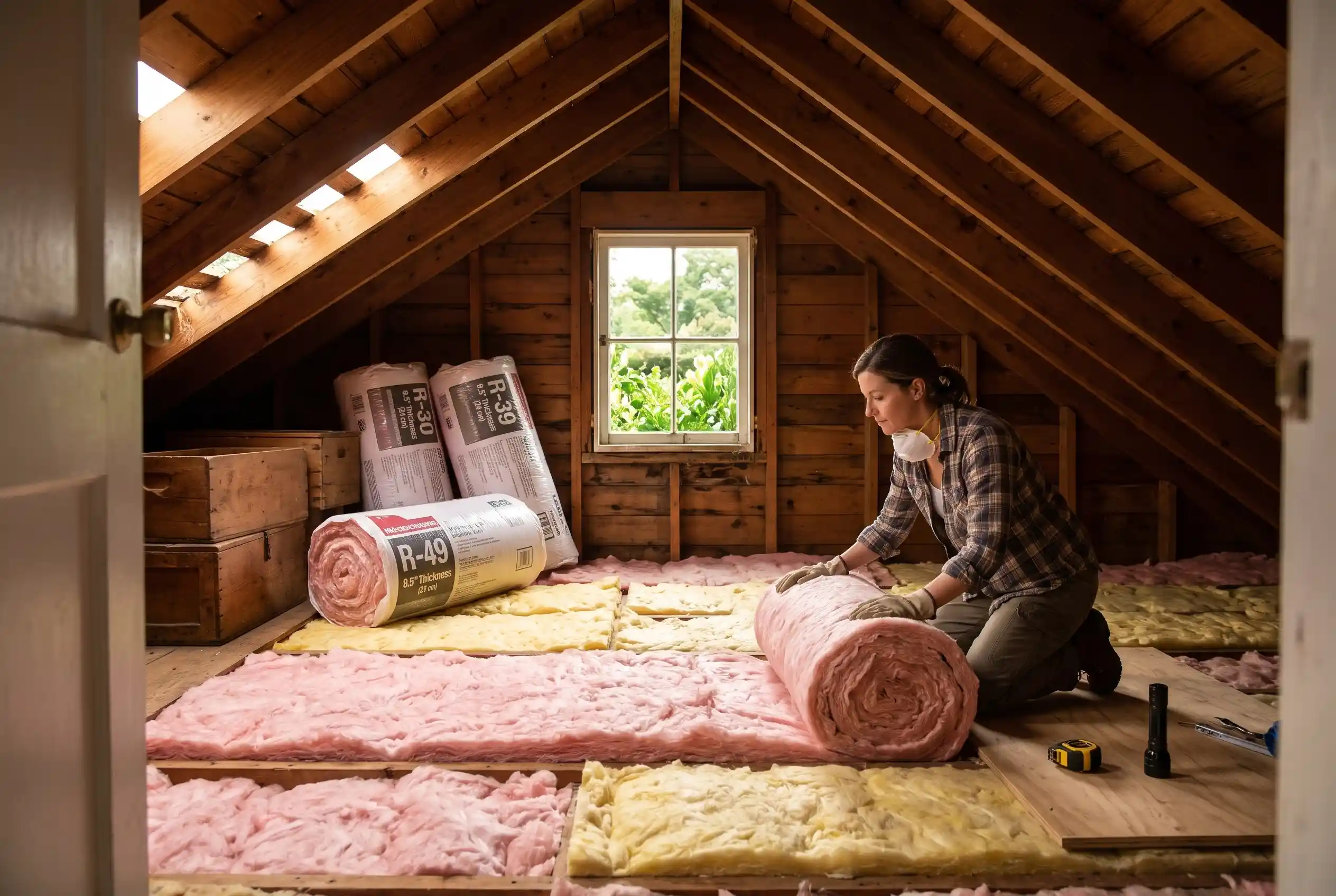
For an accessible attic, a careful visual inspection and depth measurement can give you a starting estimate. ENERGY STAR even provides guidance for identifying common insulation types and estimating R-value from depth.
- Look across the attic for exposed joists, thin patches, and uneven coverage.
- Measure insulation depth at several accessible spots without compressing it.
- Identify the material and compare its approximate R-value per inch with its label or published data.
- Check for water staining, damaged ducts, and obvious gaps without disturbing suspicious materials.
If you see older pebble-like vermiculite insulation, don’t disturb it; the EPA warns that it may contain asbestos. Have an appropriately trained professional assess any work that would disturb it. EPA safety guidance.
How to Increase Insulation R-Value
First, fix leaks in the roof or plumbing and seal appropriate air leakage paths. Then choose a compatible product to bring the existing assembly closer to your climate’s recommended level; adding loose-fill insulation over existing batts can work, and some unfaced batts can go over loose fill.
I pay special attention to attic eaves and access hatches, since missed edges leave weak spots. Keep soffit ventilation pathways open where the attic design requires them, and maintain clearances around heat-producing equipment. ENERGY STAR’s attic insulation guide explains these basics.
DIY vs. Professional Insulation Installation
Some straightforward attic-floor batt projects are manageable for careful homeowners, but I don’t recommend treating every insulation job as a weekend experiment. Consider the following before deciding:
- DIY: Accessible, dry areas with safe access, known materials, and clear installation instructions.
- Professional: Spray foam, enclosed walls, complicated crawlspaces, and major moisture damage.
- Safety first: Protect skin and lungs as directed, avoid stepping between joists, and follow fire and electrical clearances.
- Stop and assess: Suspected asbestos-containing materials, unsafe wiring, or unexplained water damage.
Is a Higher R-Value Always Better?
More resistance generally means less conductive heat transfer through the same layer, but savings don’t increase in a straight line forever. I prefer reaching a sensible target with good coverage rather than purchasing the biggest number available.
Higher R-Values, Energy Savings and Diminishing Returns
Under identical conditions, increasing a uniform layer from R-30 to R-60 roughly halves its conductive heat flow. Your total energy use won’t halve, because windows, leaks, and HVAC equipment still matter.
ENERGY STAR reports an average potential savings of 15% on heating and cooling costs, or 11% on total energy costs, from cost-effective air sealing combined with insulation improvements in typical existing U.S. homes. ENERGY STAR savings methodology.
Choosing the Right Insulation Without Overspending
Here’s how I’d prioritize the budget:
- Fix moisture problems and major air leaks first.
- Bring poorly insulated areas toward locally recommended R-values.
- Compare installed cost, required thickness, and durability, not price per package.
- Look for current state or utility rebates and confirm local building requirements.
Don’t count on an outdated federal incentive: the U.S. Energy Efficient Home Improvement Credit doesn’t apply to property placed in service after December 31, 2025, under current IRS guidance. IRS credit information. Ultimately, what is R-value in insulation comes down to understanding resistance to heat flow and choosing enough of it for the right part of your home, installed properly.
Frequently Asked Questions
Is R-30 or R-49 insulation better for an attic?
R-49 resists conductive heat flow more than R-30 at the same temperature difference. I would choose between them based on your climate zone, existing attic insulation, local requirements, and the recommended retrofit level.
What is a good R-value for exterior walls?
R-13 or R-15 is common in many 2×4 cavity applications, while R-19 or R-21 may suit deeper 2×6 framing. The complete wall may also need continuous exterior insulation, especially in colder climates.
How many inches of insulation do I need for R-38?
It depends on the material: at R-3.5 per inch, you’d need about 11 inches. I would check the product’s coverage chart because settled depth and installed density can change the actual requirement.
Can I put new insulation over old insulation?
Often, yes, provided the existing insulation is dry, safe, and in reasonable condition. For example, unfaced fiberglass batts can sometimes be added over loose-fill insulation, but you must respect air-sealing, ventilation, and moisture-design requirements.
Does insulation lose its R-value over time?
Yes, moisture, settling, compression, or aging in some foams can reduce performance. I recommend checking the material before assuming it needs replacement.
Can insulation with a higher R-value lower energy bills?
It can reduce heating and cooling demand when the home is underinsulated and the upgrade is properly installed. Savings depend on climate, utility rates, existing conditions, and whether air leaks are addressed too.